

Unitized Glass Curtain Wall Installation Methodology: A Practical Guide for Modern High-Rise Buildings
- Md. Abdul Wazed

- May 7
- 5 min read
Modern high-rise architecture is rapidly evolving toward faster construction, cleaner aesthetics, and higher-performance façades. Among all façade systems, the Unitized Glass Curtain Wall System has become one of the most preferred solutions for commercial towers, airports, hospitals, and iconic skyscrapers worldwide.
But while people admire the finished glass façade from outside, very few understand the detailed engineering, coordination, logistics, and installation methodology required behind the scenes.

From factory fabrication in another country to final installation hundreds of feet above the ground, every step requires precision, safety, and coordination.
This article provides a practical and easy-to-understand overview of the complete Unitized Glass Curtain Wall Installation Methodology used in modern high-rise projects.
What is a Unitized Curtain Wall System?
A unitized curtain wall system is a pre-fabricated façade system where large glazing panels are assembled in a factory under controlled conditions before being transported to the site for installation.
Each panel typically includes:
Aluminum frame
Glass
Gaskets
Sealants
Thermal breaks
Anchors and brackets
Unlike traditional stick systems, most work is completed inside the factory, improving quality control and reducing site labor.
Why Unitized Systems are Preferred in High-Rise Buildings
Today’s high-rise projects demand:
Faster construction
Better quality control
Improved safety
Reduced site work
Better weather performance
Cleaner architectural appearance
Unitized systems provide all these advantages.
That’s why they are commonly used in:
Commercial towers
Airports
Hospitals
Luxury residential buildings
Mega mixed-use developments
Complete Unitized Curtain Wall Installation Methodology
Step 01 — Survey & Control Setting
Every successful façade installation begins with accurate surveying.
Before installation starts, the survey team establishes:
Grid lines
Datum levels
Vertical control points
Façade reference lines
This step is critical because even a small alignment error at lower levels can create major deviations at upper floors.
Proper survey control ensures:
Correct panel positioning
Smooth joint alignment
Consistent façade appearance
Structural accuracy
In high-rise projects, survey verification is continuously checked floor by floor.
Step 02 — Cast-In Channel / Embed Installation
Cast-in channels or embedded plates are installed into the concrete structure before casting.
These embedded elements later support:
Façade brackets
Anchor systems
Unitized panels
This stage requires strong coordination between:
Façade team
Civil team
Survey team
Shuttering team
Common site challenges include:
Misalignment
Incorrect level installation
Improper edge distance
Concrete cover issues
Even small embed deviations can affect façade alignment significantly.
That is why embed inspection and clearance procedures are extremely important before concrete casting.
Step 03 — Material Handling & Storage
Unitized panels are large, fragile, and expensive.
In many projects, panels are:
Fabricated in overseas factories,
Loaded into containers,
Shipped by sea,
Transported to site,
Then lifted for installation.
Proper logistics planning is essential.
At site, panels must be protected from:
Damage
Water exposure
Scratches
Impact
Improper stacking
Storage areas should be:
Clean
Dry
Level
Accessible for lifting operations
Poor material handling can damage glass, aluminum frames, and gaskets before installation even begins.
Step 04 — Hoisting System Preparation
Before panel installation, the hoisting system must be prepared carefully.
Depending on building conditions, projects may use:
Portable winch systems
Monorail systems
Tower cranes
BMU systems
In uneven architectural areas, portable winches are often used.For repetitive typical floors, monorail systems improve efficiency.
The hoisting system must ensure:
Safe lifting
Stable movement
Controlled panel positioning
Proper load distribution
This stage also requires:
Safety inspection
Load testing
Access coordination
Wind monitoring
Step 05 — Panel Hoisting
Once lifting systems are ready, the unitized panels are hoisted floor by floor.
This is one of the most critical stages because panels are:
Heavy
Large
Wind-sensitive
Fragile
The lifting operation requires:
Skilled operators
Signal coordination
Safety supervision
Controlled movement
At high elevations, wind speed becomes a major challenge.
Improper lifting can cause:
Panel swing
Glass breakage
Alignment damage
Worker safety risks
Proper communication between rooftop and installation teams is essential during hoisting.
Step 06 — Bracket Fixing & Alignment
After lifting, façade brackets are fixed to the embedded systems.
Bracket alignment controls:
Panel level
Verticality
Joint consistency
Overall façade appearance
Engineers carefully check:
X-axis alignment
Y-axis alignment
Z-axis projection
Vertical tolerance
Horizontal tolerance
This stage determines whether the façade will look visually straight and professional from outside.
Even minor alignment issues become highly visible in glass façades.
Step 07 — Unitized Panel Installation
The unitized panels are then installed one by one.
Panels are connected using:
Interlocking systems
Anchors
Bolts
Gaskets
Stack joints
During installation, teams monitor:
Panel plumbness
Joint gaps
Glass alignment
Structural movement allowance
Installation sequencing is extremely important to maintain:
Safety
Productivity
Façade integrity
Step 08 — Joint Sealing & Weatherproofing
After panel installation, joints are sealed to ensure:
Water tightness
Air tightness
Thermal performance
Sealants and gaskets play a critical role in façade durability.
Poor sealing can lead to:
Water leakage
Air infiltration
Energy loss
Interior damage
This stage requires:
Surface cleaning
Proper backing materials
Approved sealant systems
Quality inspection
Step 09 — Water Tightness Testing
Water testing verifies façade performance before handover.
Testing methods may include:
Static water testing
Dynamic water testing
Hose testing
Chamber testing
The objective is to identify:
Leakage points
Sealant failure
Joint defects
Drainage issues
Testing is extremely important because repairing leaks after completion becomes difficult and expensive.
Step 10 — Special Area Installation
Not all building areas are typical.
Special zones may include:
Skylights
Feature façades
Inclined glazing
Crown areas
Podium connections
Canopies
These areas often require:
Custom brackets
Specialized lifting
Additional waterproofing
Complex coordination
Special areas usually consume more engineering time than standard elevations.
Step 11 — Fire Stop Installation
Fire stopping is critical for life safety.
Fire stop systems prevent:
Smoke spread
Fire spread
Heat transfer between floors
Materials may include:
Mineral wool
Fire-rated sealants
Smoke barriers
Fire-resistant boards
Proper fire stop installation is mandatory to comply with building safety codes.
Step 12 — Final Inspection & Handover
Before project completion, the façade undergoes final inspection.
Teams verify:
Alignment
Glass condition
Sealant quality
Cleaning
Panel locking
Drainage systems
Safety components
Punch points are identified and rectified before handover.
A successful handover means the façade is:
Safe
Functional
Visually consistent
Weather resistant
Ready for long-term operation
The Real Challenge: Coordination
One of the biggest misconceptions is that façade installation is only about glass installation.
In reality, successful unitized façade execution requires continuous coordination between:
Civil team
Survey team
Structural team
MEP team
Safety team
Logistics team
Consultants
Façade vendor
Without coordination, delays and quality issues become unavoidable.
Why Unitized Façade Engineering Matters
Modern façades are no longer just architectural elements.
They directly affect:
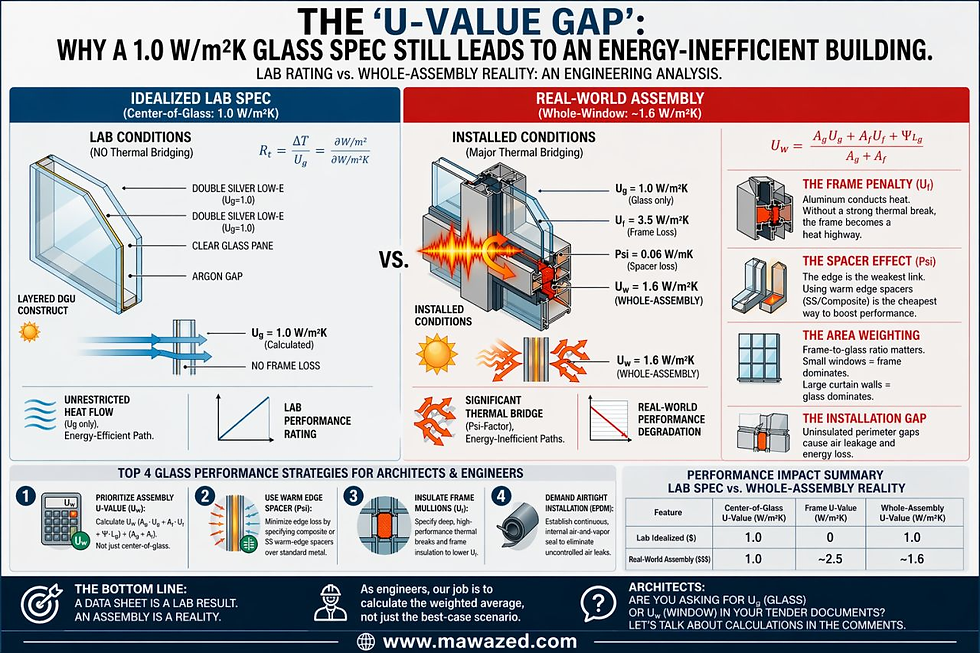
Energy efficiency
Building performance
Occupant comfort
Sustainability
Structural movement
Long-term maintenance
That’s why façade engineering today combines:
Architecture
Structural engineering
Material science
Logistics
Construction management
Safety engineering
Final Thoughts
The installation of a unitized glass curtain wall system is far more than simply placing glass panels on a building.
It is a highly coordinated engineering process involving:
precision,
planning,
logistics,
safety,
quality control,
and teamwork.
Every installed panel represents the combined effort of designers, engineers, factory teams, logistics personnel, surveyors, safety officers, and installation crews working together at extreme heights under challenging conditions.
And when executed properly, the result is not only a beautiful building façade—but a durable, high-performance envelope that defines the identity of the structure for decades.
Step by Step Installation Guideline with Photo Download link:


Comments